
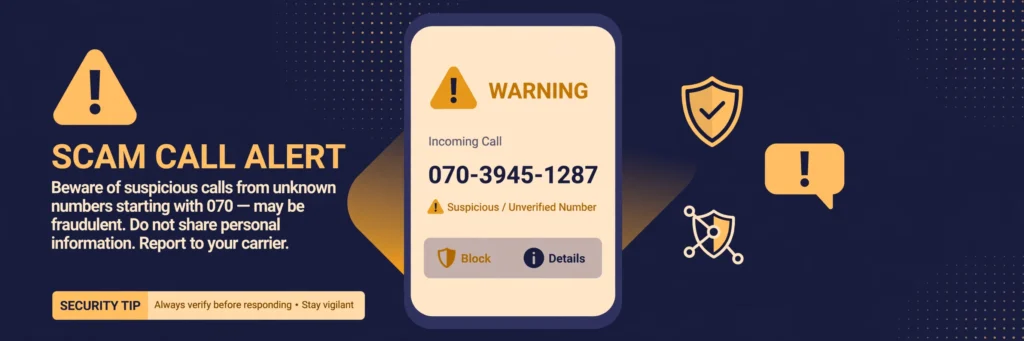
An 070 number is a UK “personal number” — a virtual number that forwards calls to another phone, not a mobile number, even though it starts with 07. Calls to 070 numbers are typically excluded from your inclusive minutes and can cost 50p per minute or more, which is exactly why scammers love tricking people into calling them back.
What Is an 070 Number?
An 070 number is a UK personal number: a virtual telephone number that forwards incoming calls to another phone, often used by businesses for “follow-me” services where one number rings several phones in turn. It is not a mobile number, even though it begins with 07. The 070 range is regulated separately from mobiles, and calls to it are charged at premium rates rather than standard mobile rates.
The legitimate idea behind 070 numbers was simple: one memorable number that follows you around. A travelling salesperson could give out a single 070 number and have it ring their office phone, then their mobile, then their home phone. In the era before cheap mobile contracts, that was genuinely useful — and the range still has legitimate business users today.
But the range has a structural problem: it looks like a mobile. UK mobile numbers also begin with 07, and most people glance only at the first two digits before deciding a number is safe to call back. That visual similarity is the root of nearly every 070 problem, from surprise bills to outright scams.
Why 070 Numbers Look Like Mobiles
070 numbers look like mobiles because both ranges begin with 07, and the human eye rarely reads further. Genuine UK mobile numbers use ranges like 071–075 and 077–079, while 070 alone is reserved for personal numbers — but spotting that difference requires checking the third digit, which almost nobody does before calling back a missed call.
The UK numbering plan groups many services under 07. When Ofcom’s predecessors allocated 070 for personal numbering, mobile phones were a luxury and the confusion seemed theoretical. Two decades later, with nearly every adult carrying a mobile, the overlap has become a daily trap: an unknown number starting 070 arrives, looks like a mobile, and gets called back without a second thought.
Scammers exploit this deliberately. An 070 number costs little to obtain, reveals nothing about the caller’s location, and arrives on your screen wearing a mobile’s clothing. Ofcom has warned repeatedly about misuse of the range, and consumer groups have long argued the similarity itself is the problem.
Why Calling an 070 Number Costs So Much
Calling an 070 number can cost 50p per minute or more because these calls are typically excluded from your inclusive minutes and billed at a premium rate set by your provider. The person or company receiving your call earns a share of that revenue — a “revenue share” arrangement — which is precisely why scammers are so keen for you to ring back.
Here is how the money flows. When you call a normal mobile, your network pays a small wholesale “termination” fee to the recipient’s network. With 070 numbers, that termination fee is far higher, and part of it flows back to whoever controls the 070 number. Your provider passes the cost to you, outside your bundled minutes, at whatever retail rate it sets — often 50p a minute or more, sometimes higher.
A five-minute returned call can therefore cost several pounds, and scammers design their lures to keep you on the line: hold music, fake menus, “your call is important to us” loops. The longer you stay connected, the more revenue the number holder collects. Always check your provider’s published call charges before ringing back any number you do not recognise — the 070 rate is usually listed under premium or special numbers.
Common Scams That Use 070 Numbers
The most common 070 scam is the missed-call trick: your phone rings once from an 070 number, and when you call back you are kept on hold while premium charges accumulate. Fake delivery, job-offer, and prize-draw scams also use 070 numbers because they are cheap to obtain, hard to trace, and benefit from the mobile-number confusion.
The one-ring missed-call scam
Your phone rings once — too short to answer — from an unfamiliar 070 number. Curiosity does the rest: you call back, hear hold music or a recorded message, and stay on the line waiting for a human. Every minute bills at the premium 070 rate. The scammer’s equipment may even play a ringing tone artificially long to stretch the call.
Fake delivery and parcel scams
A text claims a parcel could not be delivered and asks you to call an 070 number to rearrange. The number connects to a premium-rate line, not a courier. Genuine delivery companies use standard geographic, mobile, or freephone numbers — never 070.
Job and prize lures
“You have won a prize — call this number to claim” or “an employer wants to discuss your application” messages steer victims toward 070 lines. The prize never existed; the call charges are the entire business model. Treat any unexpected win or job offer arriving with an 070 callback number as a red flag.
How to Check an 070 Number Before Calling Back
Before calling back any unknown 070 number, check the number type with a free reverse phone lookup — if it identifies the number as an 070 personal number with a high spam-risk rating, do not call back. No legitimate missed call is worth a premium-rate surprise on your bill, and a two-second check removes all doubt.
The simplest rule is also the strongest: never call back an 070 number you do not recognise. A genuine caller — a business, a surgery, a courier — will either call again, leave a voicemail, or follow up by text or email. Scammers rely on curiosity; refusing to play is the whole defence.
If you are unsure, look the number up first. Type it into a reverse phone lookup and check two things: the number type (does it say personal/070?) and the risk rating. Our lookup flags every 070 number as high risk for exactly this reason. And if you are left wondering who called me from an 070 range, the lookup result usually tells you everything you need to know before you decide.
- Do not call back — let unknown 070 numbers go to voicemail.
- Look the number up with a free reverse lookup to confirm the number type.
- Block it if the call was unwanted, using your phone’s built-in blocking.
- Report it — forward scam texts to 7726 and log fraud attempts with Action Fraud.
What to Do If You Have Already Been Charged
If you have already been charged for calling an 070 number, check your bill for the exact amount, contact your mobile provider to discuss the unexpected charges, and report the number to Action Fraud if it was a scam. Some providers can place a bar on premium-rate ranges at your request, which prevents repeat charges.
Start with the bill itself. Log in to your provider’s app or website and find the call in your itemised usage — note the number, date, duration, and amount charged. This record is useful whether you are disputing the charge or reporting a scam.
Then call your provider. Explain that you did not realise the number was premium-rate and ask what options exist: some providers offer goodwill credits for first-time surprises, and most can add a premium-rate call bar to your account so 070, 09, and similar ranges simply cannot be dialled from your number in future. That bar is free and is the single best protection against a repeat.
If the call was part of a scam — a missed-call lure, a fake prize, a bogus delivery message — report it to Action Fraud, the UK’s national fraud reporting centre. Include the number, what happened, and what you were charged. Your report helps build the intelligence picture that leads to numbers being shut down.
070 vs Other UK Number Ranges
Genuine UK mobile numbers start with 071–075 or 077–079; 070 numbers are personal numbers, 0800 and 0808 numbers are freephone, and 09 numbers are premium rate. The digits after 07 tell the story — and when in doubt, a quick number lookup removes all uncertainty.
A short guide to the ranges you will meet most often:
- 071–075, 077–079: genuine mobile numbers. Standard call rates apply.
- 070: personal numbers. Premium rates, typically excluded from inclusive minutes — treat with caution.
- 0800 / 0808: freephone. Free to call from mobiles and landlines.
- 03 numbers: charged at standard geographic rates, usually included in minutes.
- 09 numbers: premium rate services with regulated price warnings.
- 01 / 02: standard geographic numbers for landlines.
The practical habit is simple: when an unknown number appears, glance at the first three or four digits, not just the first two. 0700 is the danger zone; 07700 is a perfectly ordinary mobile. Two extra digits of attention can save you several pounds.
Frequently Asked Questions
Are 070 numbers always scams?
No. The 070 range has legitimate business users — typically follow-me and virtual-number services. The problem is that the range is also cheap and easy for scammers to abuse, and its resemblance to mobile numbers makes victims easy to find. Treat unknown 070 numbers with caution rather than assuming every one is criminal.
How much does it cost to call an 070 number?
It depends on your provider, but calls to 070 numbers are typically excluded from inclusive minutes and can cost 50p per minute or more. Some providers charge higher rates. Check your provider’s published call-charge list under premium or special numbers before calling back any 070 number.
Can I block 070 numbers on my phone?
You can block individual 070 numbers exactly like any other number — via Recents in your Phone app on both iPhone and Android. You cannot usually block the entire 070 range from the phone itself, but many providers can place a premium-rate call bar on your account that stops 070 and 09 numbers being dialled at all.
What should I do if I missed a call from an 070 number?
Do not call back. If you are curious about who called me, run the number through a free reverse lookup first — it will confirm the 070 number type and show the risk rating. A genuine caller will ring again or leave a voicemail; a scammer is counting on your curiosity.
Who regulates 070 numbers in the UK?
Phone numbers in the UK are overseen by Ofcom, the communications regulator, which manages the national numbering plan and has issued repeated warnings about 070 misuse. If you believe an 070 number is being used fraudulently, report it to Action Fraud and consider flagging it with your provider as well.